
Why a food diary works at all
A food diary doesn't burn calories. What it does is close the gap between what you think you eat and what you actually eat, and that gap is enormous. Studies routinely find people underestimate their intake by 30% or more, not from dishonesty but from invisible calories: the cooking oil, the finished toddler dinner, the “few” crisps. Writing food down makes eating a decision instead of a reflex. In weight-loss research, consistent self-monitoring is one of the strongest predictors of success there is, more than the specific diet chosen.
Why most food diaries die in week two
- Friction. The old way costs 2-3 minutes per meal: search the database, pick from forty “chicken breast” entries, guess grams. Ten minutes of admin per day, forever. Nobody signs up for that twice.
- Perfectionism. One unlogged birthday dinner becomes “I ruined it,” which becomes a deleted app. The all-or-nothing reflex kills more diaries than laziness does.
- Guilt. If the log feels like a report card, avoiding it on bad days is self-protection. And the bad days are exactly the ones worth seeing.
Rules for a diary that survives
- Log at the moment of eating, not at 10pm from memory. Memory is a flattering historian.
- A rough log beats no log. “Curry, about 600” recorded is worth more than a perfect entry skipped.
- Log the bad days especially. The diary is a map, not a judge, takeaway night is data, and data is never a moral failure.
- Review weekly, not daily. Patterns live at the week level: the 4pm biscuit habit, the weekend beer calories, the protein-free breakfasts.
- Protect the streak, forgive the gap. Missed a day? Log the next meal. A diary with holes still works; an abandoned one doesn't.
The 2026 shortcut: photo logging removed the main reason diaries die. If logging takes five seconds instead of three minutes, willpower stops being part of the system.
What your diary will teach you
Give it two honest weeks and the diary starts paying rent: you'll find your personal “leak” calories (usually drinks, sauces and grazing), see which meals keep you full for four hours versus forty minutes, and learn what a genuinely satisfying 500-kcal dinner looks like at your house. That knowledge outlives the diary itself, it's the part you keep even if you stop logging.
The Calfit version
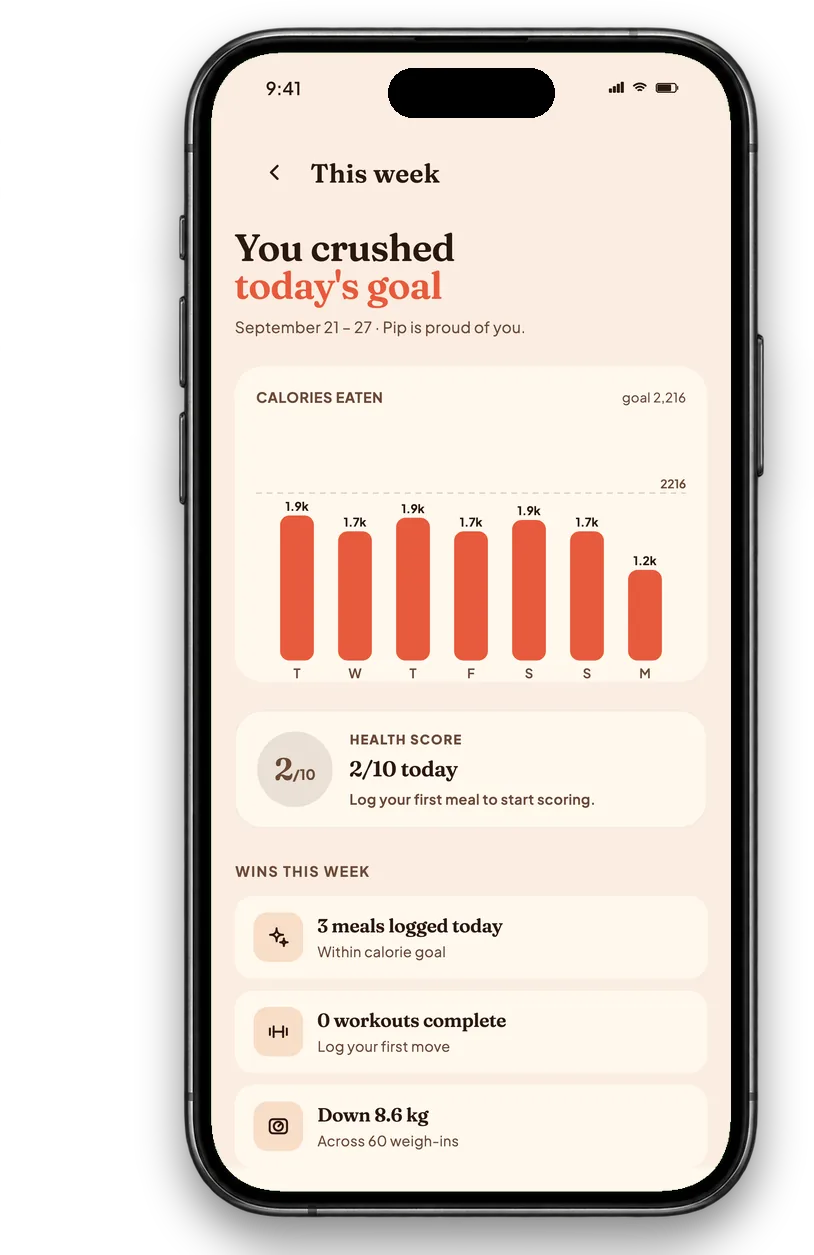
Calfit's food diary is built around the five-second log: photograph the meal, the AI fills in calories and macros, and the entry files itself under breakfast, lunch or dinner. The diary works offline, syncs when you're back, and never shows you a red angry number, just your day, honestly kept. Pip tracks the streak, notices when you show up, and is conspicuously silent about the kebab. That's the whole trick: a diary kind enough that you'll still be writing in it on day 40. For a home cooked dish before it hits the diary, the recipe nutrition calculator totals the ingredients first.
Snacks are where most diaries go quiet. Healthy snacks for weight loss lists the ones worth logging.
Sources
- Discrepancy between self reported and actual caloric intake and exercise in obese subjects, New England Journal of Medicine, 1992
- Validity of dietary assessment methods when compared to the method of doubly labeled water: a systematic review in adults, Frontiers in Endocrinology, 2019
- Self monitoring in weight loss: a systematic review of the literature, Journal of the American Dietetic Association, 2011
- Weight loss during the intensive intervention phase of the weight loss maintenance trial, American Journal of Preventive Medicine, 2008
- Log often, lose more: electronic dietary self monitoring for weight loss, Obesity, 2019
How this was made
Written by Abdullah Javaid, founder of Calfit, drafted with AI assistance and edited by hand. The under reporting figure comes from studies that compared food diaries with measured intake, and the claims about self monitoring come from the trials and reviews listed above. The screens are captures from the current Calfit app.