
The honest number
The famous “8 glasses a day” was never a scientific law, but as a rough landing zone it isn't bad. Most adults do well on about 2 to 2.5 litres of fluid a day (roughly 6-8 decent glasses), and notably that includes the water in coffee, tea, milk and food. Fruit, vegetables and soup can quietly cover 20% of your needs. Your body also ships with an excellent built-in gauge: thirst, plus urine color, pale straw yellow means you're fine; apple-juice dark means drink up.
When you need more than baseline
- Exercise: add roughly 500 ml, 1 litre per hour of sweaty training.
- Heat: summer, saunas and radiators all raise the bill.
- Illness, altitude, pregnancy and breastfeeding all push requirements up.
- Fasting windows: if you do 16:8, remember a lot of daily water normally arrives with meals, skip breakfast and you should drink some of it back deliberately.
Does water have calories?
No. Plain water has zero calories, and not in the rounded down way a diet drink does. Calories come from carbohydrate, protein, fat and alcohol, and water contains none of the four. Tap, bottled, filtered, mineral and sparkling water are all zero. The minerals in mineral water are real, but minerals carry no energy.
The calories start the moment something goes into the water. This is where a drink that feels like water quietly becomes a snack:
| Drink, one 250 ml glass | Calories, roughly |
|---|---|
| Tap, bottled, mineral or sparkling water | 0 |
| Water with a squeeze of half a lemon | 5 |
| Sugar free flavoured water or drops | 0 to 5 |
| Coconut water | 45 |
| Tonic water, regular | 85 |
| Vitamin or enhanced water, sweetened | 50 to 60 |
| Electrolyte drink, sweetened | 50 to 70 |
Why some labels say 0 when it is not quite 0
In the US a drink can be labelled zero calories if a serving has fewer than 5. That is why a flavoured water can say 0 on the front and list a few calories in the small print. One glass is irrelevant. Two litres a day of something with 4 per serving is still only about 30, so this is a curiosity rather than a problem.
Does cold water burn calories?
A little, and less than the claim. Your body warms the water to 37°C, and the physics put a ceiling of about 15 kcal on half a litre straight from the fridge. Studies that measured it found the real effect smaller still. It is a pleasant way to drink water, not a fat loss method.
Coconut water, lemon water and the ones people ask about
Coconut water is popular in India and the Philippines as a hydration drink, and it earns that: it carries potassium and it is lighter than juice. It is still around 45 calories a glass, which adds up across a hot day. Lemon water is effectively free. Tea and black coffee with no milk or sugar sit at 2 to 5 calories a cup and count toward your fluid for the day.
In Calfit: water is logged on its own, so it counts toward your hydration without touching your calorie total. Anything with calories, coconut water or tonic included, goes in as food and shows up where it belongs.
Water and weight loss: useful, not magic
Water won't melt fat, but it earns its place in a weight-loss toolkit three modest, real ways:
- Thirst wears a hunger costume. Mild dehydration often reads as snackiness. A glass of water before raiding the cupboard settles the question for free.
- Pre-meal water helps portions. A glass before meals adds a bit of fullness, studies on dieters have found it nudges intake down without any willpower spent.
- It replaces liquid calories. Every water that stands in for a juice or soda is 100-150 kcal that never needs burning. This is the single biggest hydration win for a calorie deficit.
Bonus sanity note: drink a lot of water today and the scale may go up tomorrow, water has weight. It's the good kind of heavier; the trend line knows the difference.
Making hydration automatic
- Anchor it to habits you already have: a glass on waking, one with every meal, one when the kettle goes on. Four anchors ≈ most of the day handled.
- Keep water visible. A full bottle on the desk beats a tap in another room, friction works in both directions.
- Make it nicer: cold, sparkling, a slice of lemon. You'll drink more of what you like; hydration doesn't have to be penance.
- Count something. A glass tally turns “did I drink enough?” from a guess into a glance.
Water tracking in Calfit
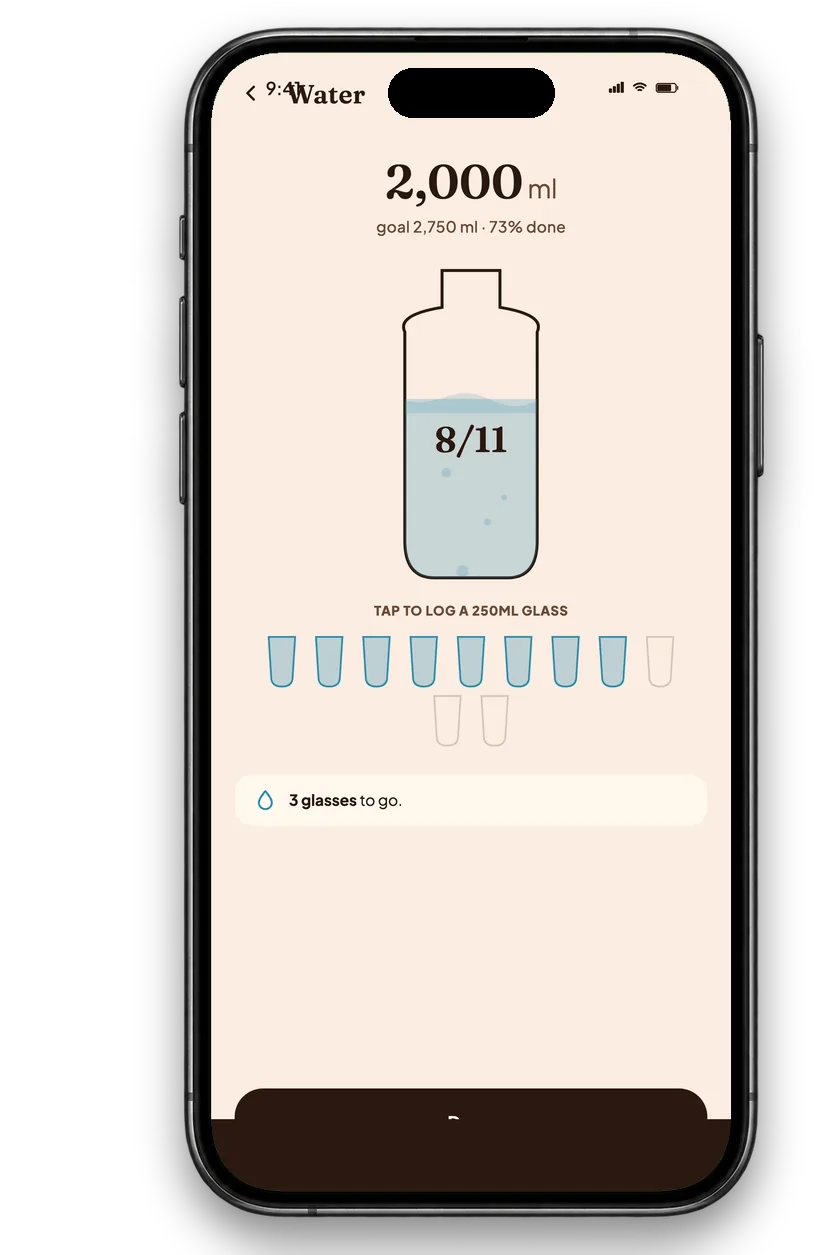
Calfit puts a one-tap water counter right on the home screen: tap, glass logged, progress bar fills toward your daily glasses. Hydration feeds into your daily health score alongside meals, movement and sleep-friendly gentle reminders, so “5 of 8 glasses” sits right next to your calories left. Small thing, honestly kept, which is rather the whole Calfit philosophy.
Sources
- Dietary Reference Intakes for water, potassium, sodium, chloride, and sulfate, National Academies Press, 2005
- Water, drinks and hydration, NHS, 2023
- Nutrient content claims for the calorie content of foods (21 CFR 101.60), US Code of Federal Regulations, 1993
- Water induced thermogenesis reconsidered: the effects of osmolality and water temperature on energy expenditure after drinking, Journal of Clinical Endocrinology and Metabolism, 2006
- Water consumption increases weight loss during a hypocaloric diet intervention in middle aged and older adults, Obesity, 2010
- FoodData Central, US Department of Agriculture, 2019
How this was made
Written by Abdullah Javaid, founder of Calfit, drafted with AI assistance and edited by hand. The daily range follows the reference intakes for total water, which count water from food and other drinks, and the drink calories are typical label values per 250 ml glass. The screens are captures from the current Calfit app.