The base math
A kilogram of body fat stores roughly 7,700 kcal. Hold a 500-kcal daily deficit and you lose about 0.45 kg a week, call it 22 weeks, or five months, for 10 kg. A gentler 400-kcal deficit lands around six months; an aggressive-but-livable 600 kcal shaves it toward four. That's the whole spread: 4-6 months, with your starting size, consistency and honesty setting where you land in it.
The week-by-week shape (so nothing surprises you)
Weeks 1-2: the flattering start
Expect 1.5-2.5 kg down, most of it water and glycogen, not fat. Enjoy it, screenshot it, and do not extrapolate it. This pace was never going to continue and its ending is not a failure.
Weeks 3-8: the real pace emerges
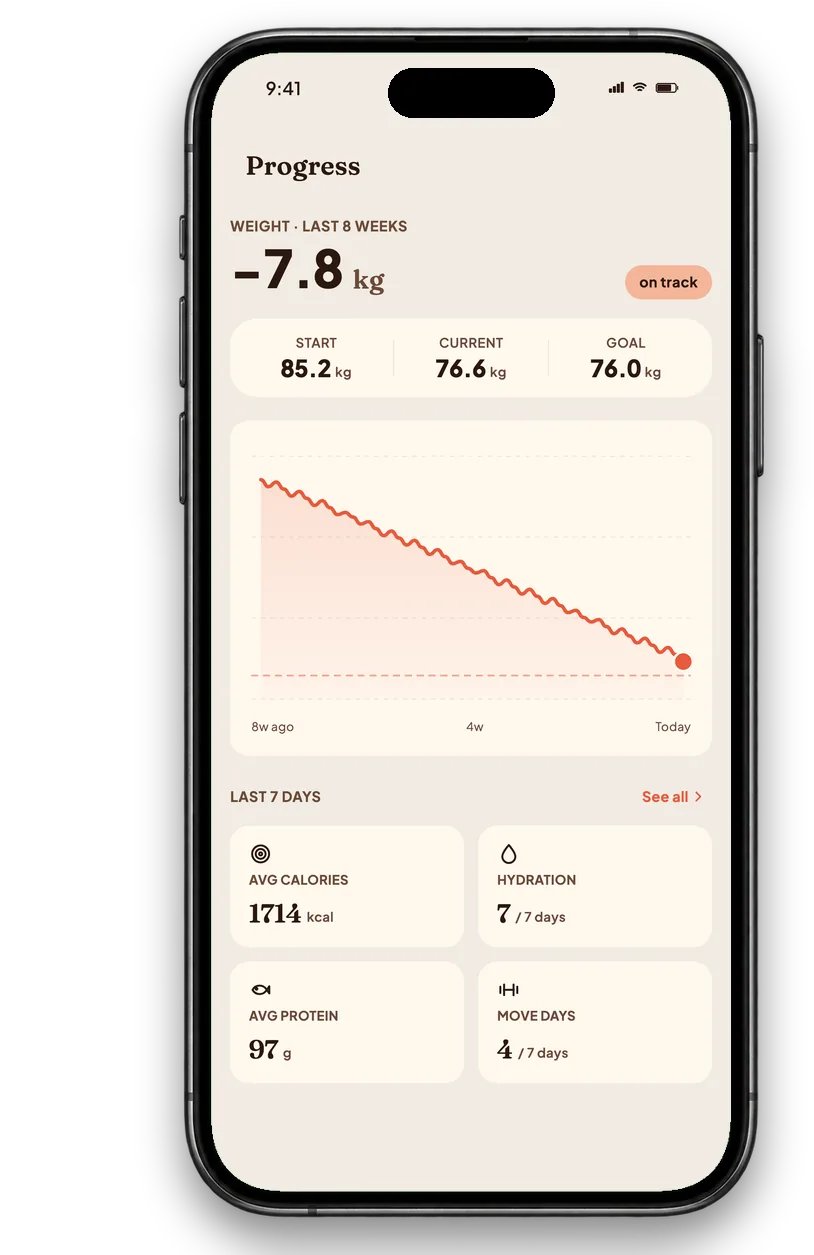
0.4-0.6 kg a week, wobbling around water noise. This is what fat loss actually looks like. The daily zigzag will try to gaslight you, judge only the 4-week trend line.
Weeks 7-10: the danger zone
Novelty gone, compliments not started yet, a flat fortnight likely (salty week, hormones, new workout, pick one). This is where most attempts die. The people who reach 10 kg aren't the ones who avoided this stretch; they're the ones who logged through it.
Months 3-5: the update phase
You're 5+ kg lighter, which means your maintenance calories dropped ~100-150/day. Recalculate (or let your app do it), expect the odd plateau, keep the streak. The last 3 kg move slower than the first 3, everyone's do.
Reframe that helps: six months sounds long until you notice it's two summers from now either way. In one version you're 10 kg lighter with a year of easy habits; in the other you're googling this again. The time passes regardless.
The same question for other amounts
The arithmetic does not change with the target, only the number of weeks does. At a sustainable 0.4 to 0.6 kg a week, which is roughly 0.5 to 0.75% of body weight for most adults:
| Target | Realistic time | In a hurry, and still sane |
|---|---|---|
| 1 kg | 2 to 3 weeks | 10 days |
| 5 kg | 9 to 12 weeks | 7 weeks |
| 10 lb, about 4.5 kg | 8 to 11 weeks | 6 weeks |
| 9 kg | 4 to 5 months | 3 months |
| 10 kg | 4 to 6 months | 3.5 months |
| 11 kg | 5 to 6 months | 4 months |
| 20 kg | 9 to 12 months | 7 months |
| 35 kg | 16 to 22 months | 12 months |
| 60 kg | 2 to 3 years | 20 months |
The right hand column is not a recommendation. It is what the arithmetic allows at the top of the safe range with nothing going wrong, and almost everything goes wrong at some point.
Two things bend this. The heavier you start, the faster the early kilos come off, because a percentage of a larger body is a larger number, so someone losing 60 kg will run well ahead of this table for the first six months and well behind it at the end. And the last 3 kg of any target take longer than the first 3, every time, because your maintenance calories fall as you shrink.
Losing 10 kg of fat is a different question from losing 10 kg
People ask about both and they are not the same thing. Scale weight is fat, muscle, glycogen, water and the contents of your gut. Fat loss is one line in that.
In a sensible deficit with enough protein and some resistance training, roughly 75 to 85% of what you lose is fat, and the rest is mostly muscle and the water stored alongside glycogen. Push the deficit harder and that ratio gets worse, which is the real cost of rushing: you arrive at the same scale number with less muscle under it and a lower maintenance intake to live on afterwards.
So 10 kg of fat takes longer than 10 kg on the scale, usually by a month or more, because you are asking for a higher quality of loss rather than a faster one. If the goal is how you look rather than what the scale says, this is the version of the question worth asking.
What 10 kg actually looks like
A common question, and a fair one, because the number means very little on its own. 10 kg is roughly a one to two dress or trouser size change for most people, and it is usually visible in the face first, which is unfair and universal.
Where it shows depends on where you started. At a higher body fat percentage 10 kg is often barely visible in photographs and very obvious in how clothes fit. Closer to lean, 10 kg is dramatic. That is why progress photographs every four weeks in the same light beat the mirror, which updates its opinion daily and is a poor witness.
Doing it healthily, which is mostly about what you keep
The phrase people use is losing 10 kg healthily, and the practical meaning of healthily is keeping the muscle and keeping the habit. Four things do most of that work:
- A deficit of 400 to 600 kcal a day, not 1,000. The larger deficit works for about three weeks and then costs you adherence, muscle and sleep.
- Protein at 1.6 to 2.2 g per kg of body weight. This is the single biggest lever on how much of the loss is fat rather than muscle, and it is covered in detail in our protein per calorie guide.
- Resistance training twice a week. Not for the calories burned, which are modest, but because it is the signal that tells your body to keep the muscle it has.
- A planned maintenance break every 8 to 12 weeks. One or two weeks eating at maintenance. It slows the calendar and improves the odds of finishing, which is the trade almost everyone should take.
The rule of thumb worth arguing with is 1 kg a week. It is everywhere, and for most people it means a deficit of about 1,100 kcal a day, which is not a diet so much as a countdown to abandoning one. It is achievable at a high starting weight and unrealistic under about 90 kg. Treating it as the default is why a lot of people conclude they have failed at week five when the arithmetic was never on their side.
What makes people actually finish
Not willpower, systems that survive boredom. Logging fast enough to do on bad days (five-second photo beats three-minute database search). A target that updates itself so the math never goes stale. A trend chart that shows progress when the morning number sulks. And a reason to open the app that isn't guilt, which is where a certain hedgehog earns his keep. Streaks turn the boring middle into a game, and the game is winnable: one logged day at a time, twenty-two-ish weeks in a row. The waist to hip ratio calculator and the weight loss percentage calculator both read progress a different way than the kilograms on the scale.
Sources
- Quantification of the effect of energy imbalance on bodyweight, The Lancet, 2011
- Body Weight Planner, National Institute of Diabetes and Digestive and Kidney Diseases, 2019
- How to lose weight, NHS Better Health, 2020
- International Society of Sports Nutrition position stand: protein and exercise, Journal of the International Society of Sports Nutrition, 2017
- International Society of Sports Nutrition position stand: diets and body composition, Journal of the International Society of Sports Nutrition, 2017
- Intermittent energy restriction improves weight loss efficiency in obese men: the MATADOR study, International Journal of Obesity, 2018
How this was made
Written by Abdullah Javaid, founder of Calfit, drafted with AI assistance and edited by hand. The rates used here are the standard 0.5 to 1% of body weight a week guidance, and the energy arithmetic uses the conventional figure of roughly 7,700 kcal per kilogram of body fat, which is a planning approximation rather than a physiological constant. The screens are captures from the current Calfit app.