Step 0: make sure it's actually a plateau
The scale being flat for 10 days is not a plateau, it's Tuesday. Water swings of 1-2 kg routinely mask a fortnight of real fat loss (here's the mechanics). The definition that saves your sanity: a flat trend line for 4+ weeks with honest logging. Shorter than that, the correct move is: keep going, change nothing.
Step 1: the honesty audit (finds the culprit ~70% of the time)
Before touching your calorie target, spend one week logging like a scientist:
- Everything, at the moment of eating. Oil, sauces, drinks, bites, the weekend. Photos help because they don't negotiate.
- Re-measure the "usual" portions. The rice scoop grows ~20% per quarter without supervision.
- Check the weekly average, not weekdays. A perfect Mon, Thu and a loose Fri, Sun is a maintenance week wearing a diet costume.
Most "plateaus" don't survive this audit. Finding 250 leaked calories isn't failure, it's the fix.
Step 2: check for stale math
If you've lost 4+ kg since setting your target, your maintenance dropped ~100+ kcal and your old deficit shrank with it. Recalculate for your current weight. (Calfit's target does this on its own, one less way to stall.)
Step 3: the actual interventions, smallest first
- Add 2,000 steps (~100 kcal/day), the cheapest deficit-widener there is. Walking math here.
- Trim ~150 kcal from the day, one sauce, one snack, one latte. Small on purpose: you may need more cuts later, spend them slowly.
- Raise protein if it's under ~1.6 g/kg, it defends muscle and quiets the hunger that widens portion drift.
- Sleep like it matters, because it does: short sleep measurably increases next-day intake and water retention simultaneously, a double-fake plateau.
- If you're worn down, take a deliberate 1-2 week diet break at maintenance. Not a metabolism trick, a morale one. Come back with the water flushed and the willpower recharged.
Never do everything at once. Cut 400 kcal, add a boot-camp and start fasting on the same Monday, and you can't tell what worked, plus week two of that plan usually ends in a takeaway. One change, two weeks, read the trend, repeat.
The plateau, seen from Calfit
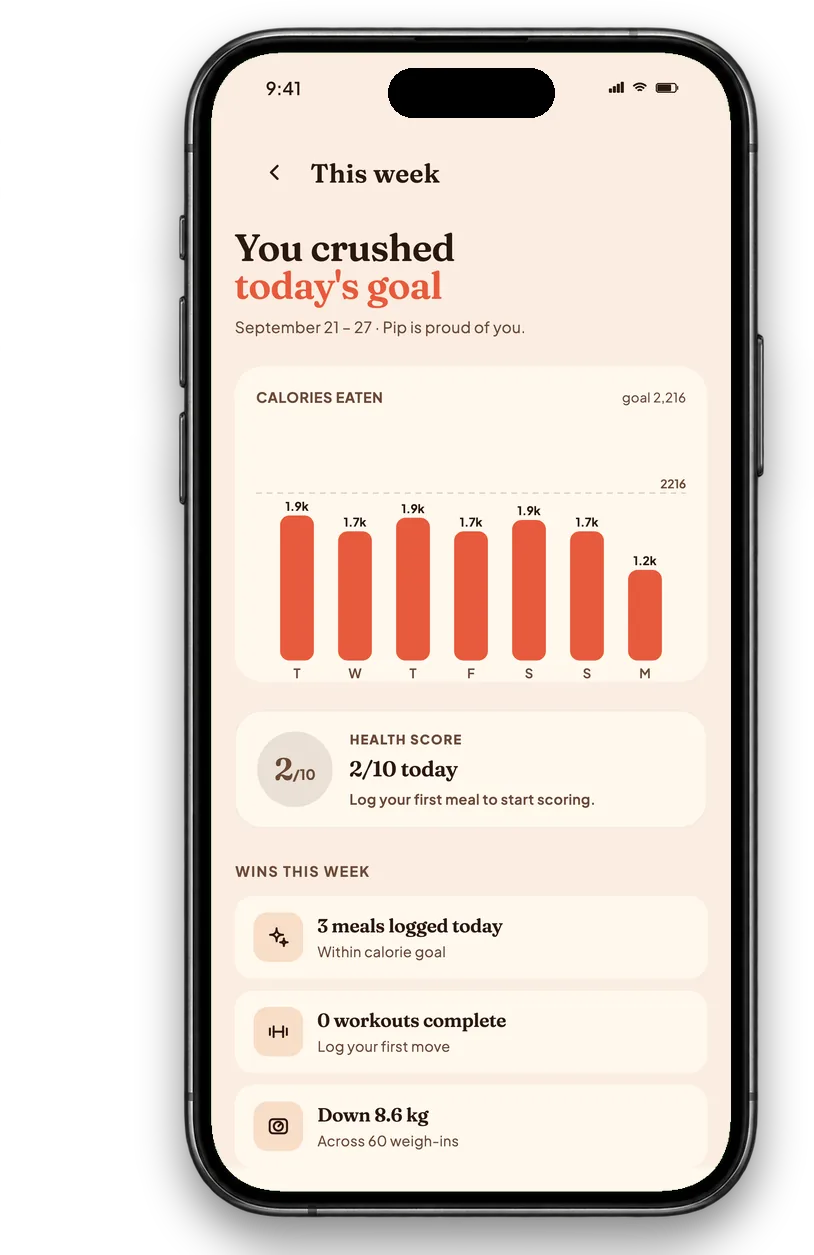
This is the exact scenario the app was built around: the weight chart draws the trend through the noise so fake plateaus expose themselves, photo logs make the honesty audit a five-second habit instead of a confession, and the adaptive target quietly handles stale math. Pip's job during a plateau is the most important one: keep you logging through the flat patch, because the streak, not the scale, is the thing you control. The weight loss percentage calculator turns the same stall into a percentage of starting weight, which reads differently than kilograms on a bad week.
Sources
- Quantification of the effect of energy imbalance on bodyweight, The Lancet, 2011
- Body Weight Planner, National Institute of Diabetes and Digestive and Kidney Diseases, 2019
- The effects of partial sleep deprivation on energy balance: a systematic review and meta analysis, European Journal of Clinical Nutrition, 2017
- Intermittent energy restriction improves weight loss efficiency in obese men: the MATADOR study, International Journal of Obesity, 2018
- A systematic review, meta analysis and meta regression of the effect of protein supplementation on resistance training induced gains in muscle mass and strength, British Journal of Sports Medicine, 2018
How this was made
Written by Abdullah Javaid, founder of Calfit, drafted with AI assistance and edited by hand. The calorie figures for extra steps are rough estimates from standard walking energy costs, and the advice to recalculate after losing weight follows the energy balance models listed above. The screens are captures from the current Calfit app.