
The overnight math that should calm you down
To gain one kilogram of actual body fat you'd need to eat roughly 7,700 calories over maintenance, call it twenty extra cheeseburgers. You didn't do that on Tuesday. So when the scale jumps 1.5 kg overnight, it is measuring something other than fat, and that something is almost always water and the weight of food in transit.
Where the phantom kilos come from
- Salt. A salty restaurant dinner makes your body retain water for a day or two. The scale reads it as gain; your fat cells never noticed.
- Carbs. Every gram of stored carbohydrate (glycogen) holds 3-4 grams of water. A pasta night can add a kilo of glycogen-water by morning, and a low-carb day can “lose” it just as fast. This is also the famous first-week whoosh of every low-carb diet.
- Food in transit. Yesterday's food has weight while it's still, let's say, in progress. A high-fiber day or a skipped bathroom visit shows up on the scale.
- Hormones. Across the menstrual cycle, water retention can swing weight by 1-2 kg, a monthly pattern worth knowing so it stops surprising you.
- Hard workouts. Muscles hold extra water while repairing. The gym session that “made you heavier” is doing exactly what you asked.
Translation: a morning weigh-in is one noisy pixel. The picture only appears when you plot a few weeks of pixels together.
How to weigh yourself without losing your mind
- Same conditions: morning, after the bathroom, before breakfast, minimal clothes.
- Weigh often, react never. Daily or near-daily weigh-ins give the trend more data, individual readings get zero emotional votes.
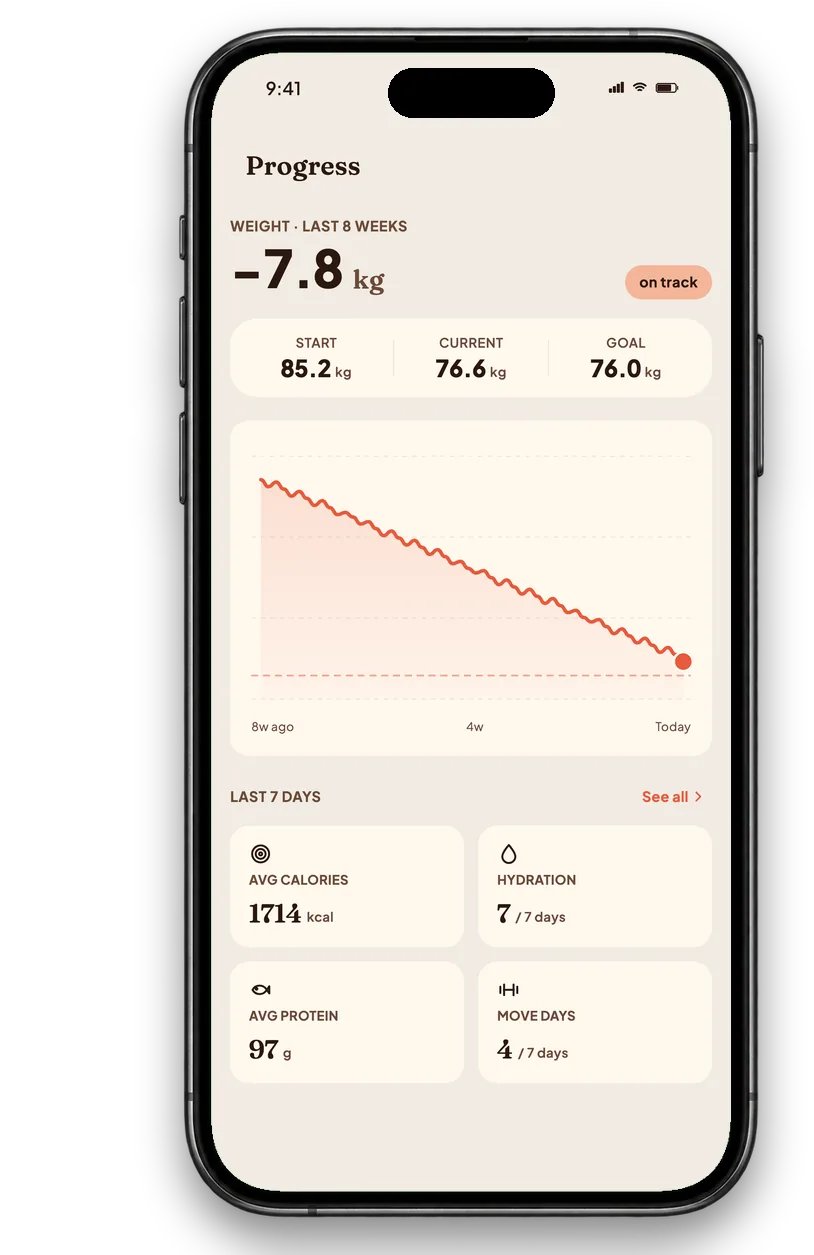
- Judge the trend line, not the dots. A smoothed line through 2-4 weeks of weigh-ins is the only number with authority. Dots wiggle; the line tells the truth.
- Zoom out on plateaus. Two flat weeks after a salty weekend is water math, not failure. Four flat weeks with honest logging means it's time to adjust the target.
Why this matters more than it seems
Scale panic is one of the biggest quiet killers of weight-loss attempts. The pattern is depressingly reliable: a phantom overnight gain, a “what's the point” morning, a skipped log, an abandoned week. The fix isn't more discipline, it's a better chart. When you watch the trend instead of the dots, random Tuesday spikes stop having the power to end your diet.
How Calfit charts it
Calfit's weight tracker draws the smoothed trend line straight through your daily wiggles, so the graph you see is the one that means something. The adaptive calorie target reads that same trend, not this morning's blip, when it recalculates your daily calories. Log the weigh-in, glance at the line, and let Pip worry about the dots. (Pip does not worry about the dots.) For a measurement the water weight can't move, the waist to hip ratio calculator tracks shape rather than mass.
Sources
- Quantification of the effect of energy imbalance on bodyweight, The Lancet, 2011
- Glycogen storage: illusions of easy weight loss, excessive weight regain, and distortions in estimates of body composition, American Journal of Clinical Nutrition, 1992
- Fluid retention over the menstrual cycle: 1 year data from the prospective ovulation cohort, Obstetrics and Gynecology International, 2011
- PMS (premenstrual syndrome), NHS, 2024
- Weighing every day matters: daily weighing improves weight loss and adoption of weight control behaviors, Journal of the Academy of Nutrition and Dietetics, 2015
How this was made
Written by Abdullah Javaid, founder of Calfit, drafted with AI assistance and edited by hand. The overnight arithmetic uses about 7,700 kcal per kilogram of body fat, and the water stored with glycogen is the 3 to 4 g per gram figure from the glycogen studies listed above. The screens are captures from the current Calfit app.